Archive for March, 2011

Mar
16

10 Ways to Make Open House Night a Success

Posted by: | Comments (0)

Last night was Open House Night at my school.


For those of you thinking about entering the teaching profession, Open House is another one of those necessary parts of your job.


Every school holds their Open House differently, but basically it’s when parents come and walk through their students’ classrooms to meet the teachers and take a look at student work. There is a lot of hand shaking and smiling.


At my school, it starts at 6:00 p.m. and ends around 8:00 p.m. Other years, I’ve gone home at the end of school, then I’ve returned for Open House. This year, however, I stayed at school, and spent a few hours decorating my classroom with student work. It made for an especially long day.


I’ve been through quite a few of these events, so over the years, I’ve learned some things to help make Open House a little less stressful. I thought I’d share them here.


So, here are 10 ways to make Open House a success:


1.       Have something that will keep the parent’s attention besides you. I like to have a PowerPoint slides show running on the television screen. I connect my computer to the TV, and loop the slide show so it runs by itself. I have a slide show with about 100 slides that have images relating to the topics we are learning in class. Other teachers have photos of their students at work on the slide show. The science teacher on my team has a small mini lab that parents can work on with the help of their students. The point is to give the parents something else to focus on instead of you. Parents can also watch the slide show while they’re waiting their turn to talk with you.

2.       Have some soft music playing in the background. This is just added decoration to a room. It makes it a more pleasant, relaxing experience.

3.       Don’t discuss grades. Some parents will want to know their child’s current grade in your class. They’ll want to know which assignment is missing or what they received on the last test. You don’t have time to look up grades or missing assignments. Tell them that they can set up an appointment with you later if they want to go over their student’s grades. Use the excuse that you don’t have the grade book with you. If you start with one parent, you’ll have to give all the parents a grade report, and that will make for a long night.

4.       Make each conversation a positive one, even with the students who drive you crazy. I never like parents to leave my class thinking that their child is a bad kid (even if he/she is). I always make sure that the student’s strengths are highlighted in my conversations. All students have strengths. Here are a few quotes I like to use to put a positive spin on the student’s weaknesses: “He’s a little too social sometimes.” “He could spend some more time studying for tests.” “I know if she spent more time on the project, she would get a better grade.” It may be a struggle in some cases, but find the good in the student. Give the parent something positive to take away from Open House.

5.       Have a project due a day or two before Open House. You want to be able to post current work around the room.

6.       Have contact information written on the board. Put your email address or website address or phone number on the board so parents can contact you.

7.       Bring water. You will get thirsty after talking to parent after parent. This is a big one. Trust me.

8.       Have a sign in sheet. Giving extra credit to students who have their parents show up is a good incentive in some cases. A sign in sheet helps you keep track. I stopped using it a few years ago, because at my school, there is never a shortage of parents showing up.

9.       Use Open House to ask for donations of classroom supplies. Have a wish list posted somewhere. Ask for anything and everything. You’ll be surprised how generous parents will be. I had a parent who owned an embroidery shop give me a great deal on t-shirts for my newspaper staff. This year, my school leadership club used Open House to raise money for the victims of the Japanese disaster. They raised a lot of money.

10.   This one I left blank on purpose. I’d like for you to fill it in. What do you do to make Open House a success?


Open House can be a tiring affair, especially when you’ve been there since the morning like I was. I must admit, however, all that tiredness went away when parents told me how much their child was enjoying my class, and how appreciative they were for making this year their best year ever. Comment like those make Open House worth all the time and effort.


Thanks for reading. Hope it helps.


Sam


Photo by: http://www.flickr.com/photos/23929749@N03/

Mar
08

10 Ways to Pass the Time While on Duty

Posted by: | Comments (0)

This week I have DUTY.

For those of you who are new to teaching or working toward your teaching career, DUTY one of those wish-I-didn’t-have-to-do-this part of your job.

What happens is that the administration will give you random assignments before or after school where you will be asked monitor students as they arrive or leave school. It normally lasts for a week, then you’ll get a few weeks off before you’re scheduled for another “tour of DUTY.”

This week I have duty on the “corner.”

I have to be out on the busy street corner making sure students don’t get hit by cars as they arrive at school.

I’m not a big fan of duty. I’d rather be in my class preparing for the day.

Since, however, I have to be out there breathing in the exhaust fumes, I thought of a few ways to make the time pass a little faster.

This is one of those blog posts that you need to print out and post in your classroom for the next time you are scheduled for duty. Really!

10 Ways to Pass the Time While on Duty

  1. Make a list of future blog post titles.
  2. Count the green cars.
  3. Practice your license plate identification skills. Do it like they do on TV: 4-7-Charlie-Alpha-3-Delta-6
  4. Wave at a random driver like they’re your old friend.
  5. Count the blue cars.
  6. Think of ways to add something extra to your lesson plan.
  7. Say “Good Morning” to students who you don’t know, and identify them by what they look like. You have to be careful with this one. Make your identifying sentence positive. “Good morning, girl with the really cool back pack.” “Good morning boy with the hair cut that’s going to make all the girls say ‘wow!’”
  8. Count how many seconds it takes for the green light to turn yellow.
  9. Count the red cars.
  10. Make a mental list of your five students who deserve a positive phone call home. Then, when you get back to class, write the list down, so you don’t forget.
  11. Extra: If you are given a walkie-talkie, start talking into it when a car flies by you going too fast. Make sure you keep looking at the car as you talk into the walkie-talkie. Just don’t press the talk button.  That driver will think twice before speeding past that corner when you’re there.


There you have it. Follow these tips, and your 15 minutes of duty will be over before you know it.

Do you have any other ideas? I would love to add them to the list.

Thanks,

Sam

Photo by: http://www.flickr.com/photos/23537201@N06/

Mar
04

Two Strategies to Teach a Tough Concept

Posted by: | Comments (0)


Hello all,

Yesterday, I had to teach my students about the Fugitive Slave Act. This was a law that allowed slave owners to go up to the North and retrieve their runaway slaves. It was part of the Compromise of 1850, and one of the causes of the American Civil War.

It’s a pretty tough concept to teach to 8th graders.

As a new teacher,  you’re going to find that there are some concepts that students have to master, but keeping their attention, because the information is complicated or boring to your students, may be difficult. The Fugitive Slave Act is one of those hard-to-get-the-kids-into-it concepts.

These are the times when I use two different strategies that have helped me better reach my students.

1. Use a current example to connect with a complex concept.

2. Make a student the star of the story.


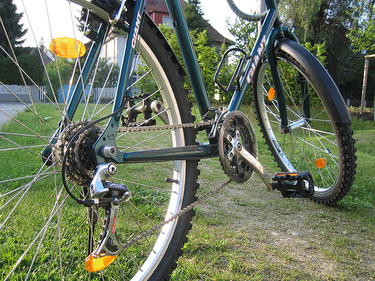
I told the class the story of Jacob (one of my students) who just got a brand new bike. (Not really – just a story I made up.)

Here Jacob is automatically elevated to celebrity status, because the story is about him. Jacob is one of those students who still doesn’t see the importance of school. On this day, however, he’s totally into the story, because it’s about him.

Jacob was riding his bike around his neighborhood when it was stolen while he took a break to get a sandwich. Distraught, Jacob tells his parents who take him to get an ice cream cone in the next city. Coming out of the ice cream shop, Jacob sees his bike, along with the person who stole it. Jacob tells his parents, and his parents call the police.

When the police officer shows up, Jacob tells him what happens, and expects the police officer to give him back his bike.

The police officer, however, determines that since the bike had crossed city lines, the bike gets to stay with the person who stole it.

Jacob is devastated.

This is when the kids in the class start shouting, “That’s not fair!” or “He can’t do that!”

That’s when I tell the class about how in the 1800’s, slave owners complained that abolitionists were helping their slaves escape to the North, and once in the free states, they had no way of getting their “property” back.

The slave owners claimed that it wasn’t fair, so to keep the South from quitting the country back in 1850, the Congress passed the Fugitive Slave Act that allowed slave owners to go up and get their slaves back.

We get into the discussion comparing Josh’s bike with slaves, and how although they are both considered property, slaves were human beings, so “stealing” them was acceptable.

I make sure to make the story interesting by adding dialogue and descriptions. I especially enjoy making Jacob cry uncontrollably in the story. (You have to be careful which student you choose for you main character. Jacob could take the joking around.)

What happens is:

  1. I get the students interested in the concept by telling a fun story.  
  2. I get Jacob (who normally wouldn’t be paying attention) to get into the lesson.
  3. I meet my goal of teaching a complicated, (and to 8th graders, a boring) concept.

Kids love stories. (Most of us like stories.)

Kids like to be the center of attention. (Most of us like to be the center of attention.)

Anytime I need to teach a hard-to-grasp concept, I try to use these two strategies to get it across.

Today, I announced to the class that Jacob got his bike back.

Jacob laughed.

Until next time,

Here’s to lots of Success in the Classroom!

Thanks,

Sam

Comments (0)