Archive for June, 2011
Great Job! I’m Proud of You. – Teachers Need a Pat on the Back Too.
Posted by: | Comments
Hello again,
Wednesday was our annual awards ceremony at our school.
Each year, we hand out awards to some of the students who have received good grades. It’s a nice evening event where parents come and take pictures of their children as the teachers and administrators hand out plaques and certificates to deserving students.
Although I’m not required to attend this event, I’ve never missed one in the 16 years that I’ve been teaching at this school.
I enjoy seeing the students get recognized for a job well done. I like shaking my students’ hands and saying, “Great Job. I’m proud of you.”
It’s one of the best parts of being a teacher.
Wednesday, however, was unlike any other awards night.
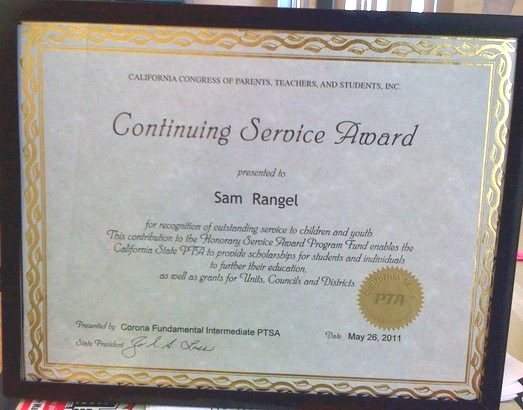
Wednesday, the PTSA (Parent Teacher Student Association) gave an award to a teacher.
That teacher was me.
The PTSA has never given an award to a teacher. They always reserve their awards for deserving students, so when the PTSA president started talking about all that the teacher has done for kids, I was totally shocked when I realized she was talking about me.
She was talking about me!
That was so cool.
All my colleagues looked at me and smiled – like they all new about it beforehand.
The audience applauded, and I know my students were proud.
It was a great night. It re-energized me, and made me want to do more for kids.
Teachers need a pat on the back too sometimes.
As a teacher, we don’t often get recognized or appreciated. We often are blamed for the lack of success of our students. Sometimes we have those days when we don’t think our efforts are being noticed.
In those times, I have to remind myself that I’m not here to get pats on the back. I’m here for the kids.
They need to know that there is someone in their corner, someone who wants them to succeed, and is willing to take the extra time to make sure that they do.
If you’re a new teacher, you’ll have those days when you’ll have the temptation to say, “Hey! What about me?” You’ll get frustrated when all people notice are your shortcomings, and they ignore all the hard work you put into your job.
That’s when you have to remind yourself that you’re not there to please the critics. You’re there to make a difference in students’ lives.
I always tell my student teachers to keep a feel-good folder. A feel-good folder is a place where you collect all the nice notes from students, the emails from parents who thanked you for a job well done, those little drawings that the students make of you, or any kind of correspondence that was positive. “When you feel unappreciated,” I tell them, ”go and read through those messages again.”
I recently received a letter from a former student who wrote me the following message:
Dear Mr. Rangel
This past week in my sociology class, we watched Tuesdays with Morie. It made me think about the teachers who have made a difference in my life. You are one of those teachers because you helped me have a love for history. You made learning history fun by being creative and finding creative ways to make learning history fun. For example your Civil War in a Can. Or your history raps. My favorite history rap was I Know My Rights history rap. Hope you’re doing good and thank you for helping me have a love for history.
Sincerely,
Melissa E.
I thought this was so cool.
The bad thing was that I didn’t recognize the name. I had to go and look her up in an old yearbook. It turned out that she left my class in 2007.
When I saw her picture, I remembered her. She was one of those students who I thought didn’t really like my class.
Go figure.
That note made my day. I stapled it on my wall near my desk, and I’ll add it to my feel-good folder at the end of the year.
Pretty cool.
So again, to you new teachers, keep doing all you can for kids, even if it seems that nobody’s noticing.
Someday, like in my case, they’ll say, “Great job. I’m proud of you.”
In case you’re curious, here’s a link to the rap that Melissa mentioned. Don’t laugh.
Thanks again,
Sam

Once again, I’m pleased to have Pooky Hesmodhalgh @CreativeEdu from the Creative Education Blog guest posting on SITC.
Here, she offers some great advice when going into that interview. I found this of particular interest, since I’m scheduled to interview for an administration position this week. Wish me luck.
Thank you again, Pooky. So, without further delay, here is: How To Succeed in Your Next Interview.
Love them or hate them, interviews are an important part of the process of progressing your teaching career. Impress at interview and the road will be a lot less rocky, but put in a bad performance and even the best CV won’t save you. Hopefully the advice I’m going to share today will help you to prepare just a little bit better for your next interview. But don’t worry, if you get the job, I won’t be asking for a slice of commission!
Know what you said in your application and be prepared to back it up
You’ve done well to have even got as far as an interview – you must have put together quite a compelling application. Make sure you’re familiar with it and that you’re able to fully explain anything you’ve mentioned if questioned. Hopefully you didn’t embellish the truth on your application, but if you did – think about how you will remedy the situation at interview if pulled up on it.
Visit the school before your interview date
Most schools will offer you the opportunity to visit the school before the interview. This is excellent homework and will give you the opportunity learn a bit about the school which you can build into your interview preparation. It will also stand you in good stead with your interviewers who will know that you’re dedicated to this job and thorough in your approach. As an interviewer I have always been less than impressed by candidates who turned down the opportunity to visit the school beforehand.
Do your homework
As well as visiting the school, get familiar with their latest inspection report, visit their website, see if they’ve been in the news lately and reach out to your personal learning network to see if you know anyone who works there who can give you the inside track. Also make sure you’re familiar with the job description and person spec and have a clear idea of how YOU fit these criteria.
Practice answering questions
Practice, practice, practice. Hop online and download sets of potential interview questions and practice answering them. Practicing aloud is a lot more effective than in your head. The best practice of all is a mock interview if you have a friend or colleague willing to help you. Ask for honest feedback though. Make sure in your preparation you’re not too easy on yourself, it’s bad news to feel wonderfully prepared only to find that the real thing is a lot tougher than you imagined as it may leave you stumbling!
Dress for the occasion
This sounds obvious but it’s crucial. Bear in mind that the wrong first impression is very hard to undo so you need to do all you can to cement a positive first impression. Dress more smartly than you usually would for the classroom, leave the comedy tie and socks at home and make sure you smell good. There is nothing more off-putting as an interviewer than the stench of body odour or garlic.
Come prepared
Bring with you all that you might need. This might mean bringing examples of any particularly relevant or innovative work you did in your last role and copies of your application and the job spec etc to keep them fresh in your mind. Also, if you’re going to be teaching make sure you bring EVERYTHING you need with you. Do not rely on the school to supply anything – from hand outs to iPads. If you can’t bring it with you, don’t plan to use it as you never know quite what will be available to you and you’ll end up in a real panic if you have to re-plan at the last minute.
Don’t be late – but don’t be too early either
Arriving late for an interview is fatal. Just don’t do it. Carry the school’s number with you in case something completley unavoidable happens. If you’re going to be late, let them know in plenty of time. Don’t arrive too early either. As an interviewer this can be a real nuisance and set you off on the wrong foot and leave you unprepared. As a rule of thumb I’d say arriving 10-15 minutes early is perfect.
The interview starts the moment you arrive
Don’t be fooled into thinking that your interview starts when you shake hands with your interviewer. It starts much earlier – form the moment you set foot in the school. You need to engage with and impress EVERYBODY. That includes the kids and the office staff. Be warm, ask questions, show an interest. You will often pick up titbits in these few minutes before the official interview that will help you and you’ll set a great first impression too.
Keep calm, project, use confident body language
You’ve finally made it into the interview room. Don’t let the panic set in. These are just a group of people who want to see you do your very best so they can decide whether you’re a good fit for their team. Even if you don’t feel confident, using confident body language will make you appear so, and often you can even convince yourself. Project your voice to ensure your points are all heard – however great your answers, they’re useless if noone can hear them.
Want the job
Some people go to interviews for posts they’re not interested in so they can practice their interview technique. This is fine in theory but you’re likely to do far better in an interview where you’re genuinely interested in the role. Your passion will shine through and impress your interviewers.
Make sure you understand and answer the questions
LISTEN! Very often people who’ve prepared well for interviews answer the question they’re expecting instead of the one they’ve actually been asked. Repeat the question in your head to ensure you know what you’re answering and ask the interviewer to repeat or rephrase the question if you need it clarified. Where possible refer your answers back to your past or future pupils and their progress.
Slow down
Candidates often feel an over-whelming urge to talk, talk, talk from the moment a question is asked. It’s okay to take a little thinking time if need be. A considered answer that truly addresses the question will outshine a long-winded one that doesn’t. One approach is to answer questions in three parts – what you believe, how your experience has led you here and what you’ll do when you’re appointed.
Share your ideas but don’t assume you know all the answers
Make sure that your answers draw on your experience – and your ideas for your future role. But be careful in how you approach this, you need to work together with the current team, so don’t alienate them by implicating that their current practice is poor. Instead explore how you can build on best practice together.
Ask questions – but not ones you should already know the answer to
Asking questions is a great way to learn more, to show an interest, and to engage further with your interviewers so ask away… but it’s a real no no to ask questions you could or should have researched beforehand. That will do nothing but highlight your lack of planning and preparation.
Treat the interview as a true two way process
Remember this is your opportunity to decide whether you’re interested in working at the school so the interview is an important fact finding mission for you as well as for your interviewers. By the end of the interview you should be in a position to know for sure whether or not you’d accept the job if offered, so be sure to explore any outstanding issues or questions you might have.
Ask for interview feedback
Not every interview will be successful. If you’re unlucky this time be sure to ask for honest feedback and act on it next time around.
Good luck! If you have any advice or experiences to share, please leave a comment.
Thank you to the following for their input into this post: @Bobtoms100 @PivotalEllie @Chris_1974 @Stuart_g_Brown @thosethatcan @reallara @ebd35 @LouiW @Joga5 @TheHeadsOffice @bob_the_teach
Ashamed and Happy to be Wrong – An Update – She’s Worth It – Part 2
Posted by: | CommentsHello all,
In the beginning of the year, I uploaded a post called, “She’s Worth It.”
It was about my experience with a student in my class who has been diagnosed with Autism. Last year, she was violent, verbally abusive, and often had the entire office staff chasing after her around the campus. It made for a very frustrating year for her teachers and the administration.
This year, she was enrolled in my class.
When the year started, she was beginning to demonstrate behaviors that began to worry me about what kind of year this was going to be.
The district paid for an outside company to come and work with the student, and this company provided this student with a full-time aide.
I have to be honest. I didn’t think that there was too much that anybody could do other than to serve as security for when the student got violent. I know that’s bad, but I’m being honest.
After a year of having this student in my class, however, I am ashamed and happy to say that I was wrong.
This student has been amazing. There have been no violent outbursts. There have been no negative behaviors at all. It’s like she is a totally different student.
Whatever this outside company did has turned an angry, violent, confused, hurting little girl into a happy, smiling, outgoing student.
I am amazed.
I’m sure the family is happy also.
I wish I could tell you exactly what this company did to effect this change, but I can’t. There was no magic treatment that changed things around.
I did observe, however, that the aide was always close by to offer help and to prevent any negative behaviors from growing out of control.
I also observed a sincere concern for the well-being of the student. The aide really cared for her, and the student responded by following her instructions - Which brings me back to my first post: She’s Worth It: Please check it out here.
Thanks,
Sam